Thought Leadership, Beyond the Marketing Cliché

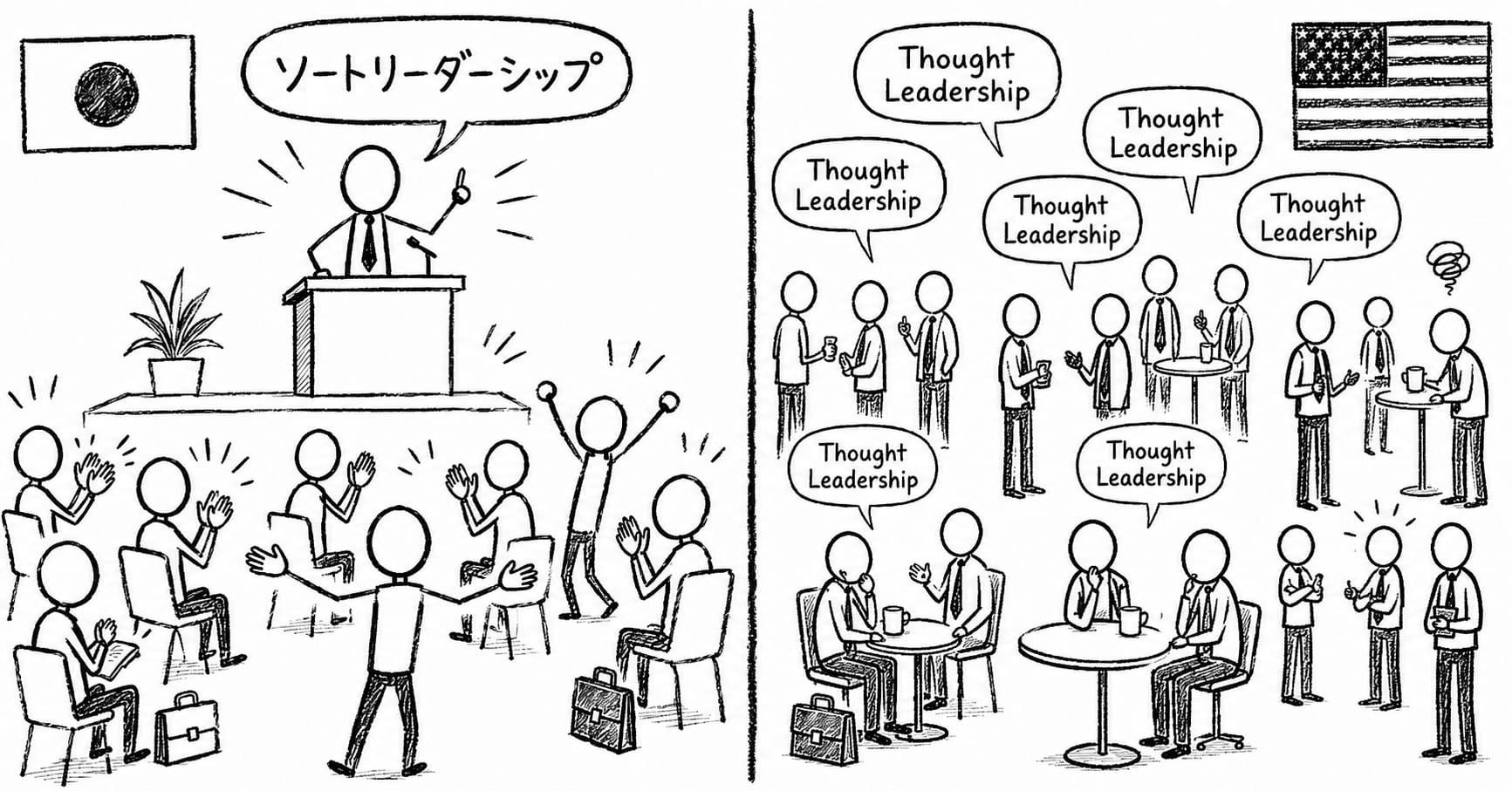
Recently, I had lunch in the San Francisco Bay Area with a former CTO of a major Japanese technology company.
One of the topics he returned to with unusual passion was thought leadership.
That phrase stayed with me after the lunch. Not because it was new to me, but because I had two very different reactions to it at the same time.
For many Japanese business leaders, “thought leadership” may still sound fresh, strategic, and global. The phrase has not yet become an everyday Japanese business cliché. When it appears as the katakana word ソートリーダーシップ, it often carries the smell of executive strategy, corporate transformation, or global management vocabulary.
But for someone who has lived in the United States for more than half of his life, and who has been active on LinkedIn for years, the phrase also carries baggage.
In the English-speaking business world, especially on LinkedIn, “thought leadership” has been overused to the point that it can now sound shallow. It is often associated with personal branding, ghostwritten executive posts, recycled management advice, and self-promotional content dressed up as insight.
That tension is what made the lunch conversation interesting to me.
The word felt risky. But the idea behind it still felt important.
The Original Meaning Was Not Shallow
Before “thought leadership” became a marketing phrase, it had a stronger meaning.
The modern business use of the term is often associated with Joel Kurtzman, an American economist, business editor, and founding editor-in-chief of strategy+business. He used “thought leader” in the 1990s to describe people with distinctive, original ideas and unique points of view in business.
The original idea was not “someone who posts frequently.” It was closer to “someone whose thinking changes how others understand an industry, a problem, or the future.”
That is still a useful idea.
A real thought leader is not merely visible. A real thought leader helps people see something they could not see before.
In business, that matters because markets are not built only by products. They are also built by interpretation. Before customers buy a new technology, before partners join a new ecosystem, before regulators understand a new category, and before employees commit their creative energy to a new direction, people need a way to understand what is changing and why it matters.
Good thought leadership provides that frame.
It says: this is the change we are seeing; this is the mistake people are making when they interpret it; this is the future we believe is possible; and this is the path we should explore together.
That is very different from saying, “Look at us. We are innovative.”
How the Phrase Became Tired
The problem is that the phrase became too useful.
Once companies and individuals realized that “thought leadership” could improve reputation, attract followers, support sales, and create executive visibility, it became a content-production category. White papers became thought leadership. Blog posts became thought leadership. LinkedIn posts became thought leadership. Sometimes even product marketing was relabeled as thought leadership.
That is where the phrase started to lose dignity.
In the English-speaking world, there is now a clear gap between the value of real thought leadership and the reputation of the term itself. Business buyers still value high-quality insight. For example, the Edelman–LinkedIn B2B Thought Leadership Impact Report continues to show that strong thought leadership can influence hidden decision-makers inside buying groups, especially when it offers fresh perspectives and helps them recognize challenges or opportunities they had not seen before.
But the same environment is also full of low-quality content pretending to be insight.
This is especially visible on LinkedIn. The platform rewards frequency, confidence, and simplicity. Those incentives can be useful when they help experts share knowledge. But they can also reward performance over substance. With generative AI, it has become even easier to produce polished-sounding opinions at scale. A person can now imitate the style of thought leadership without doing the thinking.
That is why the phrase itself has become dangerous.
If someone in the U.S. market says too loudly, “I am a thought leader,” many people will instinctively become skeptical.
My advice? Do not claim thought leadership. Practice it.
Japan Is Importing the Word at an Interesting Moment
This is why the Japanese adoption of ソートリーダーシップ is so fascinating.
Japan often imports English business words after they have already become widely used abroad. Sometimes the imported katakana word arrives before the Japanese market has fully experienced the word’s life cycle in English. The word may still sound advanced in Japan even after it has already become a cliché in the United States.
That creates both opportunity and risk.
The opportunity is that Japanese companies can use the concept seriously before it becomes diluted in the domestic market. The risk is that they may import not only the word, but also the cliché.
If Japanese leaders use ソートリーダーシップ as a fashionable label, it will quickly become another empty katakana word. But if they use it as a reminder of a deeper discipline, it can be powerful.
After that lunch, I became curious about how Japanese companies were actually using the term. The pattern I found was different from the LinkedIn-style individual branding phenomenon in the English-speaking world.
In Japan, ソートリーダーシップ still appears to be used mainly in corporate and B2B contexts. Salesforce Japan explains the term as a way for a company or individual to establish a leading position in a specific field by sharing specialized knowledge, insights, and unique perspectives. An IDEATECH survey of people involved in B2B and B2BtoC marketing also suggests that the term has meaningful awareness inside marketing circles, even though it has not become a general everyday word.
NTT DATA is one useful Japanese corporate example. In a DATA INSIGHT article on “SLOW RETAIL”, NTT DATA presents a future retail concept that questions the efficiency-first model of modern retail and proposes a slower, more human-centered retail experience. The article also identifies one of the speakers as a ソートリーダーシップ・マネジャー, which shows that the word is being used as an organizational role, not just a personal-branding slogan.
These examples suggest that in Japan, the word has not yet become primarily an individual self-branding badge. It is still more of a corporate strategy term.
That is why NEC’s usage caught my attention.
NEC’s Emphasis on “Activity” Matters
Among the Japanese examples I found, NEC stood out because it does not treat thought leadership merely as a content category.
NEC uses the phrase Thought Leadership活動 — thought leadership activity. That word “activity” matters.
NEC describes its Thought Leadership activity as a way to lead society toward a better future by sharing future-oriented empathy with customers and stakeholders, based on the social visions described in NEC 2030VISION, and by implementing social value through co-creation.
In another NEC article, titled “未来を創造する『ソートリーダーシップ活動』”, the company describes its approach as constructing and communicating a future society that people can empathize with, then working with stakeholders toward social demonstration and implementation.
That is much more interesting than “executive content marketing.”
It suggests a broader process:
First, a company must think deeply about the future it believes is coming.
Second, it must connect that future to its technology, expertise, and responsibility.
Third, it must communicate the vision in a way that others can understand and join.
Fourth, it must move from communication to co-creation, demonstration, and implementation.
This is where thought leadership becomes more than a slogan. It becomes a bridge between technological possibility and social adoption.
Why This Can Rejuvenate Innovation
Large companies often do not lose innovation because they lack smart people.
They lose innovation because they lose the habit of forming bold, coherent views of the future.
A company may have excellent researchers, engineers, salespeople, and operators. But if each function is trapped inside quarterly goals, existing customer requests, legacy product categories, or internal politics, the organization gradually becomes reactive. It improves what already exists. It serves markets that are already defined. It optimizes the known.
Thought leadership, when practiced seriously, can interrupt that pattern.
It forces the organization to ask larger questions:
What change do we see before others see it?
What social or industrial problem is not yet properly named?
What future will become possible if our technology matures?
What should customers, partners, regulators, and citizens start discussing now?
What market does not yet exist because people do not yet have the language to imagine it?
These questions are not just marketing questions. They are innovation questions.
A company that can answer them clearly is not only promoting itself. It is creating a mental map for its own people. Engineers can see why their work matters. Business teams can see where new demand may emerge. Partners can see where collaboration is possible. Customers can see a future beyond procurement requirements.
This is one reason thought leadership can help rejuvenate corporate innovation. It reconnects internal capability with external meaning.
Markets Need Stories Before They Need Products
New markets rarely appear fully formed.
Before there is a market, there is usually confusion. People sense that something is changing, but they do not yet know what to call it. They do not know which problems matter. They do not know which risks are real. They do not know which future is desirable.
This is especially true in areas like AI, robotics, digital identity, energy, healthcare, cybersecurity, aging society, education, and urban infrastructure.
In such fields, technology alone is not enough. A technically superior product may still fail if society does not understand the problem, if customers cannot justify the investment, if regulators do not know how to evaluate it, or if partners cannot imagine their role in the ecosystem.
Thought leadership helps cultivate the frontier before the market fully exists.
It gives people words, frameworks, scenarios, and values. It helps society discuss what kind of future is desirable, not just what kind of technology is possible.
In this sense, thought leadership is not only about selling. It is also about public imagination.
A company with deep technology has a responsibility to explain the future it is helping to create. Not in a manipulative way. Not as propaganda. But as an invitation to think together.
The Warning for Japanese Leaders
Still, Japanese leaders should be careful.
Internally, ソートリーダーシップ can be a useful shorthand. It can remind people that a company should not only respond to current demand, but also create future meaning. It can encourage executives and employees to ask: what is our view of the future, and how do we make that view useful to society?
But when communicating to the U.S. or English-speaking market, the phrase should be handled with restraint.
Do not overuse “thought leadership” as a badge.
Do not say “we are doing thought leadership” too often.
Do not make it sound like a branding campaign.
Instead, lead with the actual thought.
Publish the argument. Share the research. Explain the future. Name the contradiction. Offer the framework. Invite disagreement. Show the implementation path. Let the audience conclude that leadership exists.
The irony is that the more loudly one claims thought leadership, the less credible it often becomes.
Real thought leadership is recognized by others after the thinking has helped them.
Not Just for Corporate Officers
There is one more point I do not want to lose.
Thought leadership should not belong only to corporate officers, consultants, or marketing departments.
Large companies may institutionalize it. They may build teams, publish reports, create forums, and connect it to market strategy. That can be valuable. But the deeper habit should be much broader.
Every professional has a frontier.
An engineer has a view of how technology is changing the craft.
A teacher has a view of how children are changing in the age of AI.
A doctor has a view of how patients, data, and institutions are changing.
A small business owner has a view of how tools, customers, and trust are changing.
A parent has a view of how the next generation will live with machines.
A citizen has a view of what kind of society should be built.
Thought leadership, in its healthier form, begins when people take their own domain seriously enough to ask: what am I seeing that others may not yet see, and how can I explain it in a way that helps others act more wisely?
I run a small business. I am not a corporate executive of a giant company. But I still feel this responsibility in my own limited world. When I write about AI, data, local computing, or the changing nature of work, I am not trying to appoint myself as a thought leader. I am trying to understand what is happening around me and leave behind a clearer map for others.
That, to me, is the spirit worth preserving.
Beyond the Cliché
“Thought leadership” may already be a tired phrase in English.
ソートリーダーシップ may still sound fresh in Japanese.
Both facts are important.
Japan has a chance to adopt the concept without repeating the worst habits of the English-speaking business world. But that requires discipline. The word itself is not the value. The value is in the work: observing change, forming a point of view, communicating it clearly, inviting others into the conversation, and helping society move toward a better future.
If thought leadership remains a marketing label, it will deserve the skepticism it receives.
But if it becomes a practice of responsible imagination, it can help companies — and individuals — recover the courage to think beyond the current market.
Innovation does not begin only with invention.
Sometimes it begins when someone gives society a better way to understand what is coming next.